Appointment reminders for your clinic on Altegio

A missed appointment is the most expensive kind of no-show
A doctor's time is the most expensive resource in a clinic, which makes a missed appointment more costly here than in almost any other appointment-based business — an empty exam room sits idle while a waiting list of other patients goes unseen.
A patient forgetting an appointment isn't a sign of a bad clinic — it's a scheduling gap that any business faces. What makes medicine different is the size of the loss: a specialist's booked hour that goes empty cannot be recovered, and a front desk spending its morning on confirmation calls isn't doing anything a message couldn't do automatically.
Where a private clinic loses a doctor's time
- A patient forgets the appointment — the doctor's slot sits empty despite a waiting list
- Front-desk staff call every patient by hand to confirm
- A follow-up exam or a course of treatment is easy to postpone and forget
- Patient numbers end up saved in one doctor's personal phone
- A patient doesn't remember which specialist or time they're booked for
- A reminder reaches the patient in her messenger the day before and on the day of the visit
- A patient confirms with one word — front-desk time isn't spent on the phone
- Reminders about follow-ups and treatment courses go out automatically
- The patient base stays in the clinic's system, not with a departing doctor
- The reminder includes doctor, room and time — no call to the front desk needed
Scenarios built for the rhythm of a private clinic
Appointment reminders
A patient gets a reminder the day before and again a couple of hours before the visit, on the channel she actually reads. A doctor's time is a clinic's most expensive resource, so every slot saved from a no-show pays back the connection faster than in almost any other industry.
Confirmation without the front desk
Instead of an administrator calling dozens of patients the day before, Povidomlyaka asks for confirmation right in the messenger — the patient replies with one word, and the freed slot is visible ahead of time, ready to offer to someone on the waiting list.
Follow-ups and treatment courses
A six-month dental checkup, a follow-up exam, the next session in a physiotherapy course — all of these are easy to postpone and forget. A reminder about the next visit brings the patient back on time, instead of relying on her to remember preventive care on her own.
What Povidomlyaka does for a clinic

Cascade reminders
Telegram → WhatsApp → SMS: the appointment reminder reliably reaches the patient.
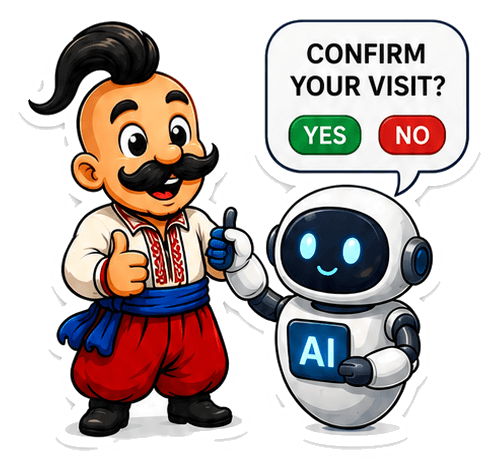
AI visit confirmation
A patient confirms in one word — the front desk stops calling everyone by hand.

Google reviews
An automatic request after the visit sends grateful patients to your clinic's listing.
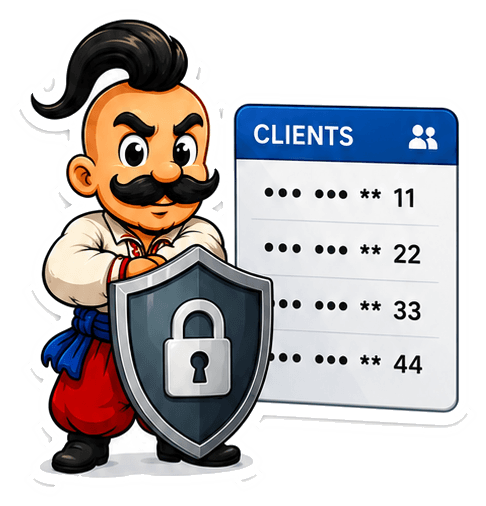
Patient base protection
A doctor leaves — contacts and visit history stay with the clinic.

Private by design
Messages run through the clinic's system, not a doctor's personal number.
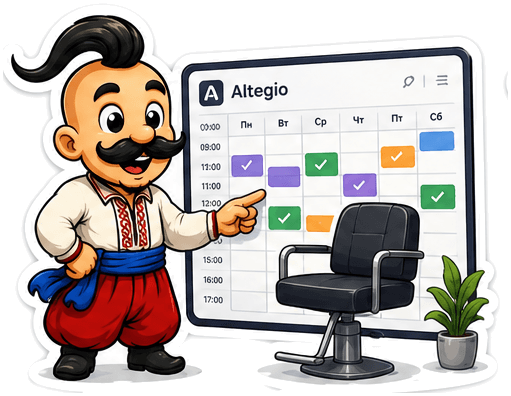
Works with Altegio
Rooms, doctors and the appointment schedule, all from one Altegio account.
Clinics, by the numbers
higher appointment attendance when a patient gets a reminder, across a 10-trial meta-analysis
J. Hospital Management & Health Policy, 2026more likely a patient is to attend after a reminder, per a Cochrane review of 8 controlled trials
Cochrane review, 2013the average appointment no-show rate — reminder research puts it closer to 2–3% once reminders go out
Etisia, No-Show Statistics, 2026Frequently asked questions
Can it remind a patient about a preventive checkup six months out?+
Yes, the reminder is tied to the next appointment date or a recommended interval, so a patient due for a follow-up exam or checkup in a few months gets a reminder closer to that date, rather than relying entirely on her own memory for preventive care.
Will patients see a doctor's personal phone number?+
No, communication runs through the clinic's system, so one doctor's personal number never becomes the sole channel of contact with a patient. That matters both for the doctor's privacy and for keeping the patient base an asset of the clinic rather than of one specialist.
How does this work in a clinic with several doctors and rooms at once?+
Povidomlyaka reads the clinic's structure from Altegio: each doctor with her own schedule, each room and each appointment type is recognized separately. The reminder is tied to the specific booking, so the patient sees exactly which specialist, room and time she's scheduled for.
Won't a reminder feel intrusive for a sensitive medical topic?+
The reminder text is neutral and businesslike: time, specialist, location and the option to confirm or reschedule. No diagnosis or procedure details appear in the message, so it stays appropriate even for a sensitive medical context.
Will this reduce the load on the front desk?+
Yes, instead of manually calling patients to confirm bookings, patients confirm directly in the messenger. The front desk sees who confirmed and who didn't, and can offer a freed slot to another patient in advance rather than discovering a no-show on the day of the appointment.
How long does setup take for a clinic?+
About ten minutes — you need access to your Altegio account, and Povidomlyaka picks up the schedule, doctors and appointment types on its own. Add a new specialist or change a schedule, and it updates automatically, with nothing to enter manually.
Can a patient reschedule directly from the reminder?+
Yes, a patient can reply to the reminder not just to confirm but to say the visit needs to move. Front-desk staff see this ahead of time and can offer another slot, so the appointment doesn't fall through at the last minute and the patient doesn't fall out of care over an inconvenient time.
Don't let a doctor wait on a patient who won't show
Connect Povidomlyaka to Altegio for your clinic — fewer no-shows and less manual calling. The first period is free.
Start free